
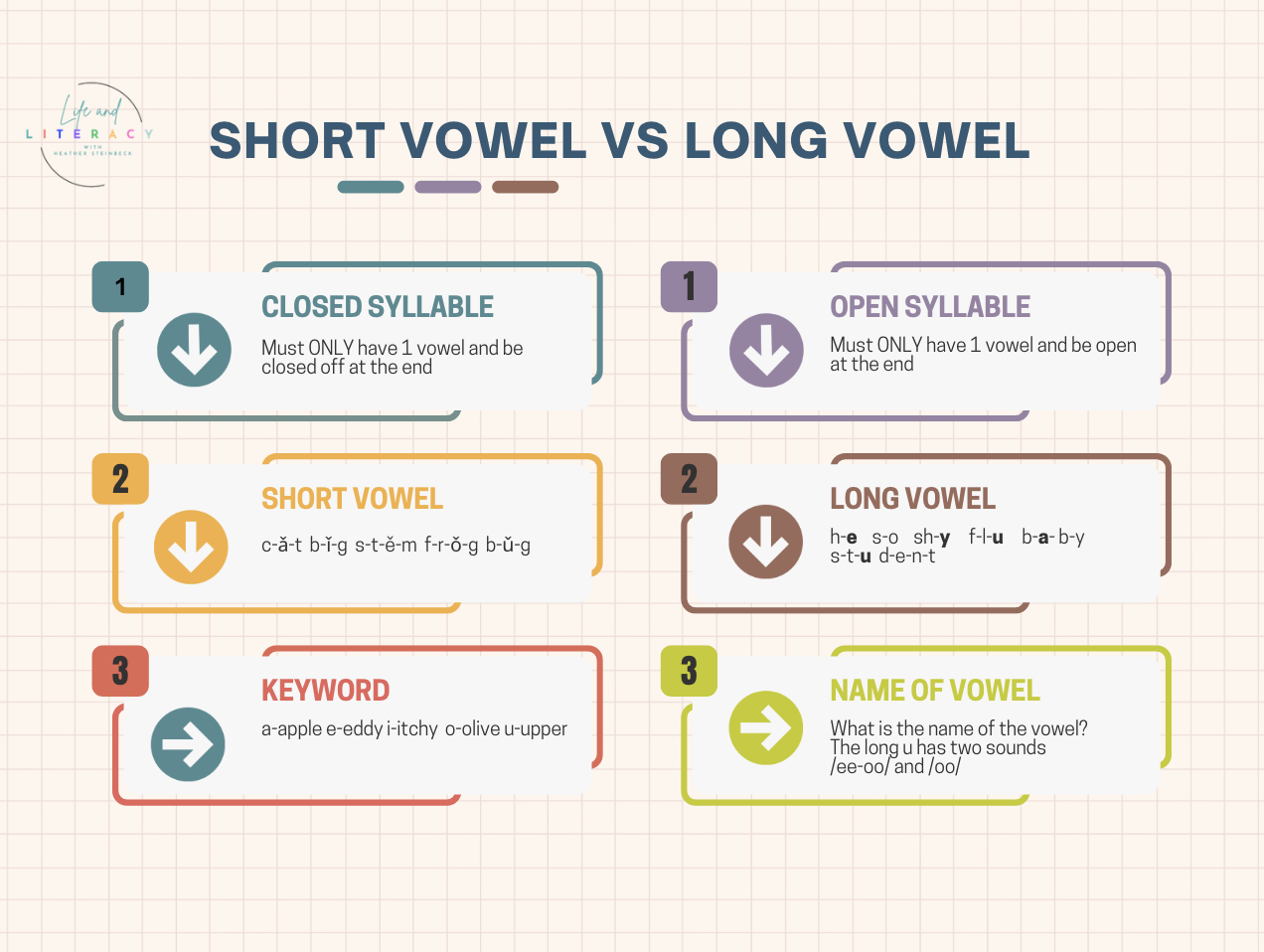
This week I want to share tips for teaching short vowel vs. long vowel sounds. Sometimes, this concept is hard for our students to grasp. Anytime you introduce a new type of syllable, we must first make sure the other syllables introduced are down solid.
What I've noticed for several of my students over the years is that they get confused on these two syllable types. OPEN vs. CLOSED. Sometimes, it's the name and terminology, but most of the time it's the actual sounds they say. Remember that the short vowel sound is the hardest one for most students to remember. So if they get stuck, always have them tap their vowels and say the keywords that have been previously taught. This will make a huge difference.
Quick Tips for Procedures
- Always use Guided Discovery instead of telling them a word is wrong.
- When spelling, give the list of words out of order
- Always have their rule sheet out to refer to in every session, including the posttest.
- In Level 4, they must have a spell checker from when you teach schwa (lesson 6) and on. They will use this spell checker from this point on until the very last lesson of the program. Be sure they have their own spell checker to take to school and use at home.
- Students must always double-check word(s) after they spell anything.
- Sight words are never to be sounded out; they are nonphonetic words.
- Make sure students are finger spelling on the correct hand and tapping syllables and vowels with the correct hand/fingers.
- For students with word retrieval difficulty, give them two options instead of having them think of their own words.
- Sprinkle questions over each lesson. Examples: Why is the C saying the /s/ sound? Does that word use the Confident or Banana rule? Where is the blend in that word?
- Never rush through a lesson to 'get it done'; every student is different and goes at a different pace.